How Often Should You Pump Your Septic Tank in Mississippi?
The short answer is every three to five years, but the real answer depends on your household.
August 20, 2026 · 4 min read
The general rule and why it varies
The standard recommendation for residential septic tanks is a pump-out every three to five years. That range comes from the EPA and from state health departments, and it holds for a typical household on a standard-sized tank. But the word "typical" is doing a lot of work in that sentence. The actual interval depends on four things: the size of the tank, the number of people in the household, how much water the household uses, and whether the kitchen has a garbage disposal.
A family of four on a 1,000-gallon tank will fill the sludge layer faster than a couple on the same tank. A household that runs the washing machine daily adds more water volume than one that runs it twice a week. And a garbage disposal sends food solids directly into the tank that would otherwise go in the trash, which thickens the sludge layer faster than the bacteria can break it down.
What is actually happening inside the tank
A septic tank separates wastewater into three layers. Grease and lightweight solids float to the top and form a scum cap. Heavy solids sink to the bottom and become sludge. The middle layer is relatively clear liquid called effluent, and that is the only part that is supposed to leave the tank. It flows out through the outlet baffle and into the drain field, where the soil provides the final stage of treatment.
The bacteria inside the tank break down some of the settled solids over time, but they cannot keep up with a steady incoming load. The sludge layer rises and the scum layer thickens, and at some point one of them reaches the outlet baffle. When that happens, raw solids travel out into the drain field lines and start clogging them. A clogged drain field is one of the most expensive septic repairs a homeowner can face, and it is almost always preventable with routine pumping.
Signs your tank might be overdue
- Slow drains throughout the house, not just one fixture. A single slow drain is usually a pipe problem. Multiple slow drains at the same time suggest the tank is full and effluent is not leaving fast enough.
- A sewage odor in the yard, especially near the tank or the drain field. The smell means untreated wastewater is surfacing, which means the system is backed up.
- Standing water or unusually green grass directly over the drain field. The grass grows faster because it is being fertilized by surfacing effluent.
- Gurgling sounds in the plumbing when a toilet flushes or a sink drains. That is air being displaced by water that has nowhere to go.
- Any sewage backup into the house. This is the last stage and the most urgent. The system is full and nothing is leaving the tank.
How pumping works
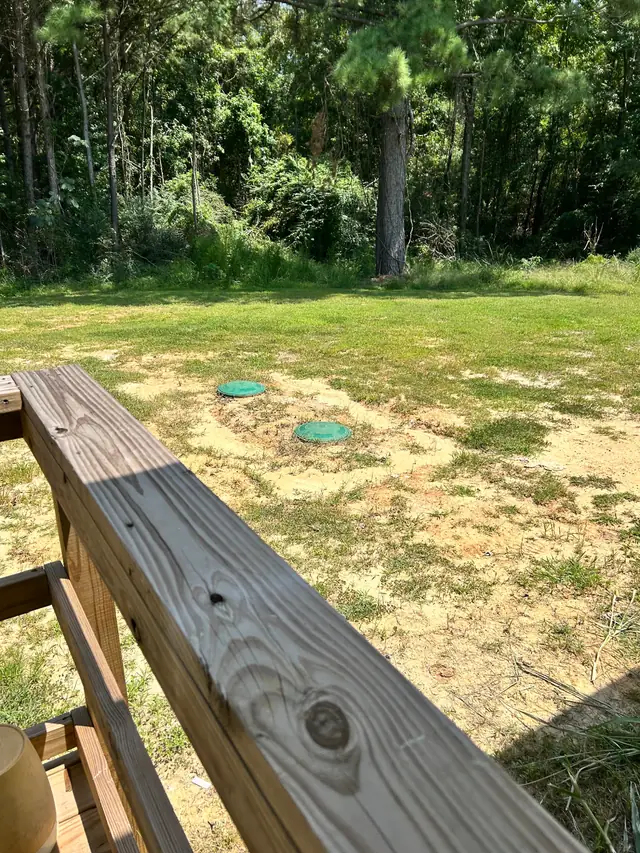
A pump truck connects a large-diameter hose to the access riser on the tank. The operator pumps the contents of the tank into the truck, including the scum cap, the liquid, and the settled sludge. While the tank is open and empty, a good technician will check the inlet and outlet baffles for damage, look at the tank walls for cracks or root intrusion, and note the condition of the seams.
The whole process usually takes 30 to 45 minutes for a residential tank. If the access riser is buried under soil, there is additional time spent locating and uncovering it. One of the best things a homeowner can do is install a riser that extends to grade level so the lid is at the surface. It saves time and money on every future pump-out.
Setting a schedule that fits your property
Rather than guessing, the simplest approach is to have the tank inspected during the first pump-out after you move in. The technician can measure the sludge depth and the scum thickness and tell you roughly how fast the tank is filling based on the household size you describe. From there, a recommended interval falls out naturally: a two-person household on a 1,500-gallon tank might go five years easily, while a five-person household on a 1,000-gallon tank might need service every two to three years.
The Mississippi Department of Health oversees septic systems in the state. Permit and maintenance requirements can vary by county, so it is worth checking with your local health department office to confirm what applies to your property.
Get your tank checked
Lacey's Digging Service, Inc. has been pumping septic tanks across Flowood and Rankin County for over 30 years. The team can inspect your system, pump it, and set up a recommended schedule based on how your household uses water. Call (601) 939-6511 to get on the schedule.
More articles
Five Warning Signs Your Drain Field Is Failing
A failing drain field gives warnings before it gives up entirely. Here is what to watch for.
What Happens During a Septic Inspection?
Whether you are buying a house or just checking on your system, here is what the process looks like from start to finish.