Five Warning Signs Your Drain Field Is Failing
A failing drain field gives warnings before it gives up entirely. Here is what to watch for.
August 20, 2026 · 4 min read
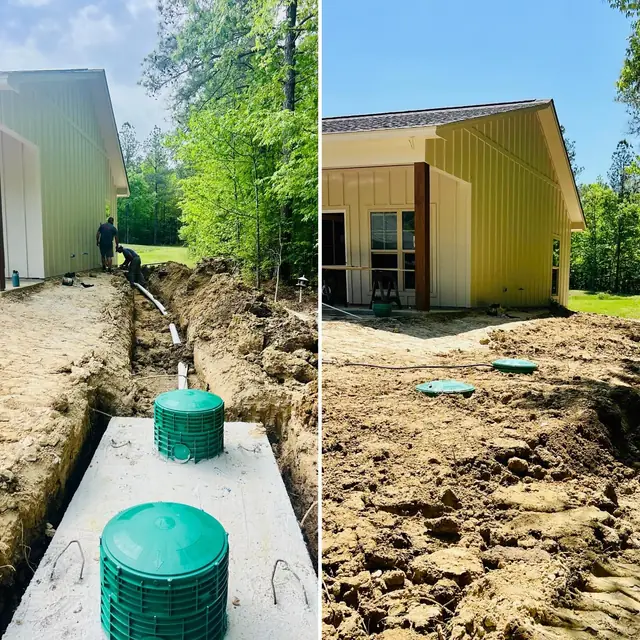
The drain field is the part of a septic system that most homeowners never think about, because when it is working correctly there is nothing to see. It is a network of perforated pipes buried in gravel-filled trenches, and its job is to disperse the liquid effluent from the septic tank into the surrounding soil, where bacteria in the top few feet of earth handle the final stage of treatment. When the drain field starts to fail, the signs show up gradually and are easy to dismiss one at a time. Taken together, they paint a clear picture.
1. Standing water over the drain field
The most visible sign is water pooling on the surface directly above the drain field, especially when there has been no recent rain. This means the soil can no longer absorb effluent at the rate the tank is sending it out. The liquid has nowhere to go, so it rises to the surface. In Mississippi's clay-heavy soils this can happen seasonally after heavy rain, but if it persists during dry weather, the field is struggling.
2. Unusually green or fast-growing grass in one area
A strip of grass that is conspicuously greener and taller than the rest of the yard, sitting directly over the drain field lines, is being fertilized by effluent that is surfacing or sitting close to the root zone. The nitrogen and phosphorus in partially treated wastewater are effective fertilizers. A well-functioning drain field distributes effluent deep enough that the grass above it looks the same as the rest of the yard. When that changes, the effluent is closer to the surface than it should be.
3. Sewage odor in the yard
A properly functioning septic system should not produce any noticeable odor at the surface. If there is a persistent sewage smell near the drain field or around the tank, it means untreated or poorly treated wastewater is reaching the surface or venting improperly. The smell is often strongest in the morning or evening when the air is still and the temperature drops. It is not something that will resolve on its own, and it is a clear signal that the system needs attention.
4. Slow drains throughout the house
A single slow drain is usually a clog in the pipe serving that fixture. Multiple fixtures draining slowly at the same time is a different problem. It typically means the water leaving the house has nowhere to go: the tank is full, the drain field is saturated, or both. The water backs up in the main line and the symptom appears at every fixture. Toilets, showers, and kitchen sinks all slow down at the same time. If plunging or snaking one fixture does not fix the others, the issue is downstream in the septic system.
5. Soggy or spongy ground when walking over the field
Even before water pools visibly on the surface, the ground over a failing drain field can feel soft or spongy underfoot. The soil is waterlogged because the effluent is not percolating as fast as it is arriving. This is the earliest physical sign and the easiest to miss, because it takes a deliberate walk across the field to notice it. Checking the field after a dry spell is the most informative: if the ground is still damp when the rest of the yard is dry, the drain field is telling you something.
What causes drain field failure
The most common cause is solids leaving the septic tank. When a tank goes too long without pumping, or when a baffle fails and lets floating scum past, solids enter the distribution lines and coat the gravel bed. Over time a layer of biological buildup called a biomat forms at the soil-gravel interface, sealing the trench bottom and preventing absorption. Vehicle traffic or heavy equipment driven over the field can compact the soil and crush the pipes. Tree roots can infiltrate the pipes or compress the gravel bed. And in Mississippi, the clay content of the soil itself can limit absorption even in a well-maintained system.
What to do if you spot these signs
The earlier a drain field problem is caught, the more options are available. A partially clogged field may respond to jetting the lines and pumping the tank aggressively for a season. A fully sealed field typically needs to be excavated and rebuilt. Either way, the first step is a professional inspection that includes opening the distribution box to see which lines are flowing and which are backed up.
Lacey's Digging Services has been doing drain field work in Flowood and the surrounding Rankin County area for over 30 years. If your yard is showing any of these signs, call (601) 939-6511 and the team will come assess the situation.
More articles
How Often Should You Pump Your Septic Tank in Mississippi?
The short answer is every three to five years, but the real answer depends on your household.
What Happens During a Septic Inspection?
Whether you are buying a house or just checking on your system, here is what the process looks like from start to finish.